


 On tire sidewall

 Inside the door jamb


Load index is the number on your tire's sidewall that tells you its weight capacity. It's easy to skip over, but the wrong load index puts safety and tire life at risk. This guide breaks down what load indexes mean, how they compare to load range, and how to pick the right one for your vehicle.
Tire Load Index Explained
The load index is essentially a rating that quantifies a tire's capacity to bear weight. The concept is pretty straightforward. The higher the load-carrying capacity of a tire, the higher its load index number.
This number can be found right next to the tire size, and it's usually represented as a combination of numbers and letters, such as 94 H. In this example, 94 is the load index and H represents the speed rating. Click here for an in-depth look at speed ratings.
Deciphering load index numbers
Load indexes are typically expressed as numbers that range from 0 to 150, although passenger vehicle load indexes start around 88. The higher the number, the greater the load-carrying capability of the tire.
- Higher load index: increase in capacity. A tire with a load index greater than your original equipment manufacturer (OEM) tire, signifies an increase in load capacity, which is important when you need to carry heavier loads or want a more robust tire for safety.
- Identical load index: same capacity. A tire with the same load index as the OEM tire maintains your vehicle's original load capacity. It's the safest choice.
- Lower load index: A red flag. A lower load index than the OEM tire means it doesn't meet the original load capacity specifications and will compromise your safety and the overall performance of your vehicle.
Never downgrade your load index
Never go lower on the load index when replacing your tires. For example, if your current load index is 103, a tire with a load index of 112 that matches the size is a suitable replacement. A tire with a load index of 94 would be a mistake because lower load indexes can cause bubbling and, in worst cases, blowouts that endanger safety and tire life.
Tire Load Index and Speed Rating Charts 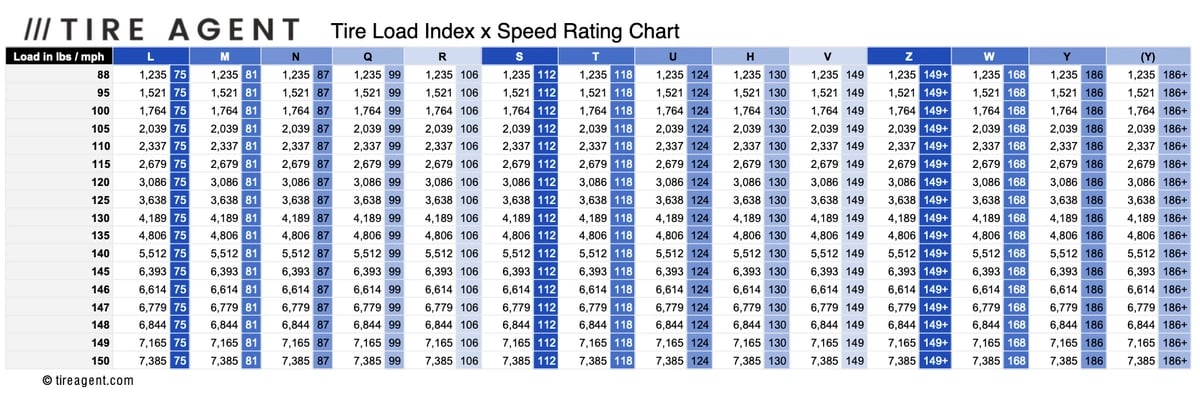
Downloads: We've prepared two downloadable versions of the tire load index and speed rating chart. The abridge version is easier to download, print and view on mobile devices; the full version is ideal for desktop viewing.
- Load index rating chart (abridged)
- Load index rating chart (full)
Why Does Tire Load Rating Matter?
Tire load ratings determine how much weight your tires can safely carry. Choosing the correct load rating is essential for safety, reliable performance, and tire longevity. Underrating your tires (using a lower load index) leads to reduced traction, accelerated wear, and tire failure. Going higher than required is safe. Going lower is not.
What is the load rating range for light trucks and SUVs?
Light truck and SUV tire load indexes typically range from 70 to 126. The specific load index you need depends on your vehicle's weight and its intended use. Consult your vehicle's door jamb label or owner's manual for your OEM load rating requirement. Never go lower than the manufacturer's specs, especially if you haul things or have made alterations to your vehicle, such as adding a tool box or roof rack.
What is the load rating range for commercial truck tires?
Commercial truck tires have significantly broader load ratings than light truck tires, typically starting around 120 and reaching up to 150. Because commercial trucks carry heavy loads, you must match or exceed your vehicle manufacturer's load rating. Going lower than the OEM specification puts your cargo, your vehicle, and your safety at risk. Always consult your vehicle manufacturer's specifications to determine the correct load rating for your truck.
What is the load rating range for passenger vehicles?
Passenger vehicle tire load indexes typically range from 75 to 100, though some are higher. The specific load index you need depends on your vehicle's weight and design. Check the owner's manual or door jamb for your OEM load rating requirement. Never go lower than the manufacturer's specs, to ensure safe handling and tire performance.
What is the load rating range for trailer tires?
Trailer tire load indexes vary significantly by trailer type and capacity. A utility trailer may need a load index around 80 to 100, while an enclosed or specialty trailer (boat, car hauler) can require 110 to 120 or higher. Check your trailer's manufacturer plate for the exact load rating. Never use tires rated lower than specified. A trailer tire failure at highway speeds creates serious safety risks for you and other drivers.
Load Range vs Load Index
So, what's the difference between load range and load index? Load range deals with the tire's inflation pressure capabilities, while load index focuses on the tire's ability to bear weight. Here's a quick breakdown.
Load range
- Load range indicates the maximum air pressure a tire can safely hold and the load it can carry at that pressure.
- It's usually indicated by letters like C, D or E on the sidewall.
- A higher load range indicates a tire that can support heavier loads at higher inflation pressures.
Load index
- The load index is a numerical value that specifies the tire's load-carrying capacity.
- It is represented as a number, typically ranging from 88 to 150 on passenger vehicles, and can be found on the tire sidewall.
- A higher load index signifies a greater load-carrying capacity for a specific tire size.
Answers to FAQs About Load Index
What's the relationship between load index and GVWR?
Your vehicle's GVWR (gross vehicle weight rating) is the maximum total weight it can safely carry. Your tires' load indexes must support that weight. Divide your GVWR by the number of tires to find the minimum load capacity each tire needs. For example, a truck with an 8,000 lb GVWR and four tires needs each tire to support at least 2,000 lbs. Always match or exceed your OEM tire's load index to stay within safe limits.
How do I read load index on a tire?
Load index is a number found on your tire's sidewall, right after the tire size and before the speed rating. It looks like this: 225/65R17 94 H. The 94 is the load index; the H is the speed rating. Consult a load index chart to see what weight that number represents. For example, 94 equals 1,477 pounds per tire.
Is load index per tire or for all four tires?
Load index is per tire. Each tire on your vehicle has its own load capacity. To find your vehicle's total load capacity, multiply the load index weight by the number of tires. For example, if each tire has a load index of 100 (1,764 lbs), four tires support a total of 7,056 lbs.
What does "extra load" on a tire mean?
Extra load (often marked XL on passenger tire sidewalls) indicates a tire that can carry more weight at higher inflation pressure than a standard load tire of the same size. Standard load tires max out at 36 PSI; extra load tires can handle up to 42 PSI. Extra load tires are useful if your vehicle is heavier or you frequently carry cargo.
What load index do I need for my vehicle?
Check your vehicle's door jamb label (usually inside the driver's door frame) or your owner's manual for the OEM tire specification. It will list the correct tire size, load index, and speed rating. Never use a load index lower than recommended. If you tow, haul, or have modified your vehicle, consult the manufacturer to confirm you need a higher load index.
Where do I find the load index on my tire?
Load index is printed on the tire's sidewall. Look for the tire size code (e.g., 225/65R17), followed by a two or three-digit number and a letter. That number is your load index; the letter is the speed rating. On light truck tires, you'll see two load indexes separated by a slash (e.g., 117/112) because dual rear wheels carry different loads.
What load range do I need for towing?
Your tires must support both your vehicle's weight and the trailer's weight. Check your vehicle's door jamb label and your trailer's manufacturer plate for load specifications. Most towing requires at least a load range D or E on light truck tires. If you tow frequently or carry heavy loads, consult your vehicle and trailer manufacturers to determine the correct load index and range.
What is the maximum load rating on a tire?
Maximum load rating refers to the weight capacity at maximum inflation pressure for that tire. It's determined by the tire's load index. For example, a tire with a load index of 110 can carry up to 2,337 pounds at its rated pressure. Always inflate your tires to the pressure listed on your vehicle's door jamb. This ensures you can safely carry your vehicle's maximum load.
ID 343327592 | Wodthikorn Phutthasachathum | Dreamstime.com


 No Money Down
 No Credit Needed
 Early Buyout Options
 Flexible Payments


